


Table of Contents
- Why Comparing Insurance Quotes Matters
- How Many Insurance Quotes Should You Get
- Create an Insurance Quote Comparison Checklist
- Compare Insurance Coverage Limits and Deductibles
- Top Ways to Compare Insurance Quotes Online
- Insurance Comparison Websites Privacy Considerations
- Verify Your Quote Before Making a Decision
- Get Expert Guidance on Your Insurance Quotes
- Frequently Asked Questions
Last Updated: October 12, 2026
Why Comparing Insurance Quotes Matters
Getting the right insurance coverage at a fair price requires more than accepting the first quote you receive. When you compare insurance quotes across multiple providers, you gain visibility into the range of options available to you and the actual cost differences between insurers.
The challenge most people face is that comparing quotes manually takes time and requires discipline. You need to gather information from multiple sources, ensure you’re looking at identical coverage levels across each quote, and then actually evaluate the results.
At SVF Insurance Agency, we help individuals and families navigate this process. We often find that people underestimate how much their rates can vary between insurers. When you take the time to compare insurance quotes properly, you typically find options you didn’t know existed, and you often uncover coverage gaps in your current policy that need addressing.
How Many Insurance Quotes Should You Get
The practical answer is between three and five quotes. This range gives you enough data to identify price trends and spot outliers without becoming overwhelming. Getting fewer than three quotes means you’re basing your decision on limited information.
The real benefit of multiple quotes isn’t just comparing prices. Each quote reflects how that insurer assesses your specific risk profile. One company might charge more because they weight driving history heavily. Another might offer better rates because they specialize in your demographic or vehicle type.
Start with three quotes as your baseline. If those three show a wide range in pricing, getting a fourth or fifth quote can help you determine whether you’ve found a genuine outlier or if there’s a broader market trend you’re missing. If the first three quotes cluster around similar pricing, you’ve likely identified the market rate for your situation.
Create an Insurance Quote Comparison Checklist
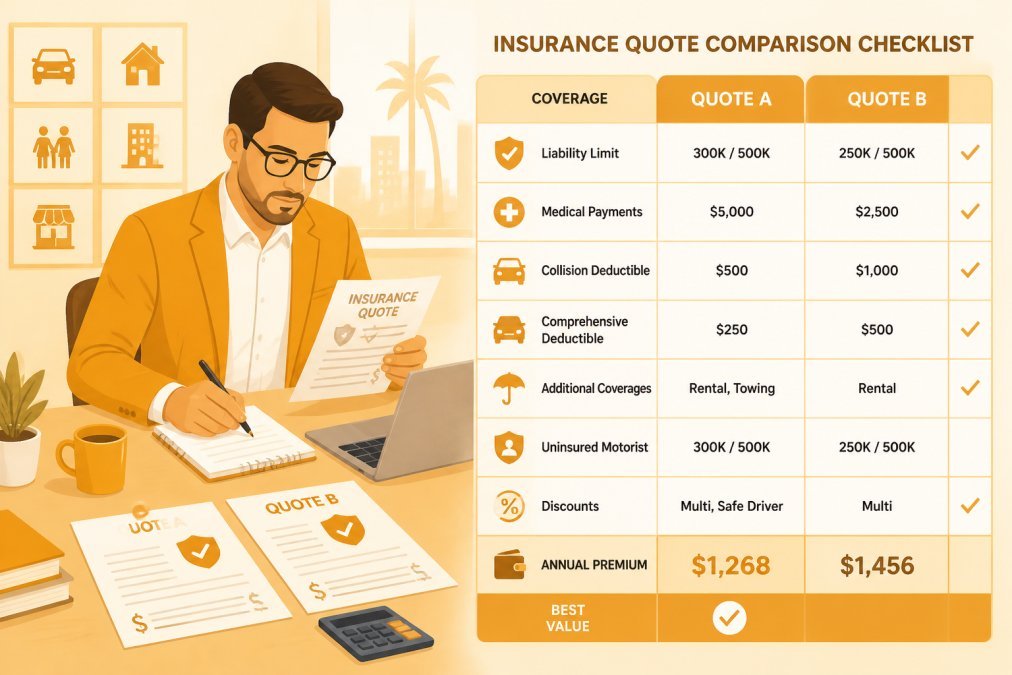
The single most important tool for comparing quotes is a structured checklist that forces you to evaluate each quote against the same criteria. Without one, you’ll end up comparing different things, one quote with high liability limits and low deductibles versus another with the opposite structure. That’s not a real comparison; it’s confusion disguised as analysis.
What to Include in Your Checklist
Your checklist should capture three categories of information: coverage limits, deductibles, and optional features.
Coverage limits are the maximum amounts your insurer will pay for different types of claims. Liability coverage limits determine how much the company will pay if you’re at fault in an accident and someone else is injured or their property is damaged (Auto Insurance Basics). Collision coverage limits apply to damage to your own vehicle from a collision. Comprehensive coverage limits cover other types of damage like theft, weather, or vandalism.
Deductibles are the out-of-pocket amounts you pay before insurance kicks in. A higher deductible means lower monthly premiums but higher costs if you actually have a claim. A lower deductible means higher monthly premiums but lower out-of-pocket costs when you need to file.
Optional features vary by insurer but commonly include roadside assistance, rental car coverage, gap insurance, and accident forgiveness programs. These don’t apply to every situation, but they can add real value depending on your circumstances.
| Comparison Element | Details to Record | Why It Matters |
|---|---|---|
| Liability coverage limits | Bodily injury & property damage amounts | Determines protection if you’re at fault |
| Collision deductible | Dollar amount per claim | Affects monthly cost and claim expenses |
| Comprehensive deductible | Dollar amount per claim | Covers non-collision damage |
| Uninsured motorist coverage | Limits included or excluded | Protects you from uninsured drivers |
| Optional add-ons | Roadside, rental, gap insurance | May save money or provide valuable protection |
| Monthly premium | Total cost per month | Your actual out-of-pocket expense |
Compare Insurance Coverage Limits and Deductibles
This is where most people make mistakes. They look at the monthly premium number and stop. But the premium is only part of the true cost equation. A quote with a lower premium might have higher deductibles, which means you’d pay more out of pocket if you actually need to file a claim.
Matching Coverage Across Quotes
Before you compare prices, make sure you’re actually comparing the same coverage. Request quotes with identical liability limits, collision limits, comprehensive limits, and deductible amounts across all providers. If one insurer quotes you with 100/300/100 liability coverage and another quotes 50/100/50, you’re not comparing apples to apples, the first quote is for better coverage and will naturally cost more.
The standard approach is to request each quote at a baseline level first. Many insurers offer recommended coverage limits based on your vehicle value and assets. Start there, get all your quotes at that level, and then request variations if you want to explore different deductible or coverage combinations.
Understanding Deductible Trade-offs
A deductible is a direct tradeoff between monthly cost and claim costs. Raising your deductible from $500 to $1,000 typically lowers your monthly premium by 10-15%, but it means you’d pay an extra $500 out of pocket if you have a collision claim.
The right deductible depends on your financial situation and risk tolerance. If you have an emergency fund that covers $1,000 easily, a higher deductible makes financial sense, you’ll save money on premiums over time, and you can handle the out-of-pocket cost if needed. If a $1,000 unexpected expense would strain your budget, a lower deductible is worth the higher monthly cost because it protects your finances.
Top Ways to Compare Insurance Quotes Online
You have three primary channels for gathering quotes: online comparison tools, direct insurer websites, and independent insurance agents. Each approach has different strengths.
1. Online Comparison Tools
Services like online comparison tools let you enter your information once and receive quotes from multiple insurers simultaneously. The process typically takes a few minutes, and you see side-by-side quotes from numerous companies in some cases.
The advantage is speed and breadth. You’re not visiting individual insurer websites, and you’re not repeating the same information multiple times. The disadvantage is that you’re limited to insurers that participate in that particular platform, and the quotes are preliminary, they often require additional verification before becoming binding.
These tools work best as a starting point. Use them to identify which insurers offer competitive pricing in your market, then get confirmed quotes directly from those companies.
2. Direct Insurer Websites
Going directly to an insurer’s website gives you their full range of quotes and customization options. You can adjust coverage limits and deductibles in real time and see how each change affects your premium.
The advantage is control and accuracy. You’re getting quotes directly from the source, and you can explore different scenarios without intermediaries. The disadvantage is time. You’ll repeat your personal information and vehicle details for each insurer, and you won’t see how that company compares to others until you’ve completed their entire quote process.
3. Independent Insurance Agents
An independent agent represents multiple insurers and can shop your information across their entire network. They handle the legwork of gathering quotes and presenting options to you. This approach is particularly valuable if your situation is complex, multiple vehicles, business coverage, or special circumstances that require expert guidance.
The advantage is personalized service and expertise. An agent can explain coverage options in detail, identify discounts you might miss on your own, and help you understand the tradeoffs between different quotes. The disadvantage is that you’re relying on an intermediary, and you need to trust that they’re presenting you with genuine options rather than steering you toward higher-commission products.
SVF Insurance Agency operates as an independent agent, which means we can compare quotes across multiple trusted carriers and help you understand which option actually fits your situation best. Rather than pushing you toward a single company, we show you the real differences between your options.
Insurance Comparison Websites Privacy Considerations
When you use an online comparison tool, you’re sharing personal information, your name, address, driving history, vehicle details, and sometimes financial information. That data has value, and you should understand how it’s being used.
Most comparison websites share your information with the insurers whose quotes you request. That’s how they generate quotes quickly. Some also sell your information to insurance agents and brokers, or use it for marketing purposes. Read the privacy policy before entering your information, and look for opt-out options if you don’t want your data shared beyond the quotes you’re requesting.
A safer approach for privacy-conscious people is to use direct insurer websites instead of comparison tools. You’re still sharing information, but you control exactly which companies receive it. Alternatively, work with an independent agent who can gather quotes on your behalf, you share your information with one trusted source rather than multiple platforms.
Verify Your Quote Before Making a Decision
A quote is not a binding commitment. It’s an estimate based on the information you provided. Before you make a final decision, verify that your quote is accurate and that you understand what you’re actually buying.
Contact the insurer directly and confirm that the quote reflects your actual driving record, vehicle information, and requested coverage levels. Ask whether there are additional discounts you qualify for that weren’t applied to the initial quote. Some insurers offer discounts for bundling home and auto insurance, completing a safe driving course, or maintaining continuous coverage that don’t always appear in online quotes.
Also confirm the effective date and any conditions that apply. Some quotes are valid for only 30 or 45 days. If you’re comparing quotes over time, make sure you’re looking at current quotes, not ones that have expired.
Get Expert Guidance on Your Insurance Quotes
After you’ve gathered and compared your quotes, the final step is deciding which option actually makes sense for your situation. This is where expert guidance adds real value, especially if your circumstances are complicated or if you’re uncertain about coverage levels.
SVF Insurance Agency can review the quotes you’ve gathered and help you understand the real differences between your options.
If you’re shopping for home and auto insurance together, bundling can significantly reduce your overall costs. We can help you structure that bundle to maximize savings while ensuring you have adequate coverage for both your vehicle and your home.
Comparing insurance quotes requires discipline and attention to detail, but it’s one of the most direct ways to control your insurance costs.
For personalized guidance on your specific situation, contact SVF Insurance Agency. We’ll review your quotes, explain your coverage options, and help you find the right balance between cost and protection.
Frequently Asked Questions
How many insurance quotes should I get before choosing a policy?
Most experts recommend comparing at least three to five insurance quotes to identify competitive rates and coverage options. Gathering multiple quotes from different insurers helps you understand the range of available premiums and ensures you’re not overpaying. Online comparison tools make it easy to collect quotes from numerous providers quickly, though working with an independent agent can streamline the process by accessing quotes from multiple carriers at once.
What should I compare besides the premium when shopping for insurance?
Beyond monthly or annual premium costs, compare coverage limits, deductibles, out-of-pocket maximums, and specific coverage options like liability, collision, comprehensive, or uninsured motorist protection. Evaluate the insurer’s customer service reputation, claims handling speed, and financial stability. Also check available discounts, policy terms, and any additional features relevant to your situation. An insurance agent can help ensure you’re comparing identical coverage across quotes so premiums are truly comparable.
Can I compare insurance quotes without sharing my personal information?
Most online comparison tools and insurance quote requests require basic personal and vehicle information to generate accurate quotes. However, you can limit what you share by providing only essential details initially. Be cautious about which comparison websites you use; review their privacy policies to understand how your data will be used or shared. Working directly with an independent insurance agent or contacting insurers individually gives you more control over your personal information while still allowing you to compare coverage options and rates.
How do I compare insurance quotes with different coverage limits?
To make fair comparisons, standardize the coverage limits across all quotes you receive. Start by deciding what liability coverage, collision limits, and comprehensive coverage you need based on your vehicle and financial situation. Request quotes using identical coverage amounts from each insurer so the premium differences reflect only rate variations, not coverage differences. This apples-to-apples approach ensures you’re truly comparing rates rather than confusing lower premiums that result from lower coverage. Your insurance agent can help align coverage specifications across multiple quotes.