


Table of Contents
- Why Homeowners Are Seeking a Florida Insurance Center Alternative
- What Changed in the Florida Home Insurance Market
- How to Compare Homeowners Insurance Quotes Step by Step
- Independent Insurance Agency Benefits for Florida Homeowners
- Questions to Ask Your Insurance Agent Before You Switch
- Coverage Types, Deductibles, and What Homeowners Insurance Covers
- How to Switch Home Insurance Providers Without a Coverage Gap
- Frequently Asked Questions
Last Updated: September 14, 2026
Why Homeowners Are Seeking a Florida Insurance Center Alternative
The floridainsurancecenter alternative for homeowners search has grown louder for one reason: the state-backed insurer of last resort was never built to be a permanent plan. Citizens Property Insurance exists to cover properties that cannot find coverage in the private market, and it now sits far outside that purpose. At SVF Insurance Agency, we talk to homeowners every week who want to explore their options.
Two forces pushed them there: a wave of carrier exits and non-renewals that left whole ZIP codes scrambling, and premium increases on renewals that had already stretched household budgets thin.
The market has since shifted. Insurers are filing to re-enter, and many homeowners who fled to the state-backed insurer now have real options again, but leaving takes planning, not a phone call.
Below, we break down what changed, how to shop quotes properly, and how to switch carriers without a single day of lapsed coverage.
What Changed in the Florida Home Insurance Market
The market shift matters because it changes who can leave the state-backed insurer of last resort, and how. To understand whether a floridainsurancecenter alternative for homeowners is realistic for you, you need the mechanics, not just the headline that “rates are falling.”
Three things changed at once:
- Litigation costs came down. Legislative reforms limited one-way attorney fees and assignment-of-benefits abuse, which had driven defense costs and premiums (flsenate.gov). Carriers responded by filing rate decreases and reopening to new business in areas they had abandoned.
- Reinsurance costs eased. After years of steep increases, the cost of reinsurance carriers buy against catastrophic losses began to moderate. It is a large line item in every premium, so when it stabilizes, filings follow.
- The state-backed insurer began actively shedding policies. Through its depopulation program, private carriers are approved to make “takeout” offers to assume a policy. If the offer is at or below the state insurer’s premium for comparable coverage, the policyholder can be moved.
That third point is the one homeowners feel most. Under current rules, a policyholder can generally be transitioned to a private carrier when its offer is at or below a defined threshold compared with the state-backed policy (Depopulation Resources – Public). The state insurer also encourages shopping private quotes and publishes comparison tools.
The practical takeaway: if you were priced out two years ago, that pricing may no longer exist. But “eligible to leave” and “ready to leave” are different questions, confirm the private offer matches your coverage, not just your premium.
Do not cancel your existing policy before a new one is bound and confirmed. A gap in coverage, even a few days, can trigger a higher rate or a denial on your next application.
How to Compare Homeowners Insurance Quotes Step by Step
Comparing quotes properly means normalizing every policy to the same coverage limits, deductibles, and endorsements before you look at price. A cheaper premium on thinner coverage is not a cheaper policy.
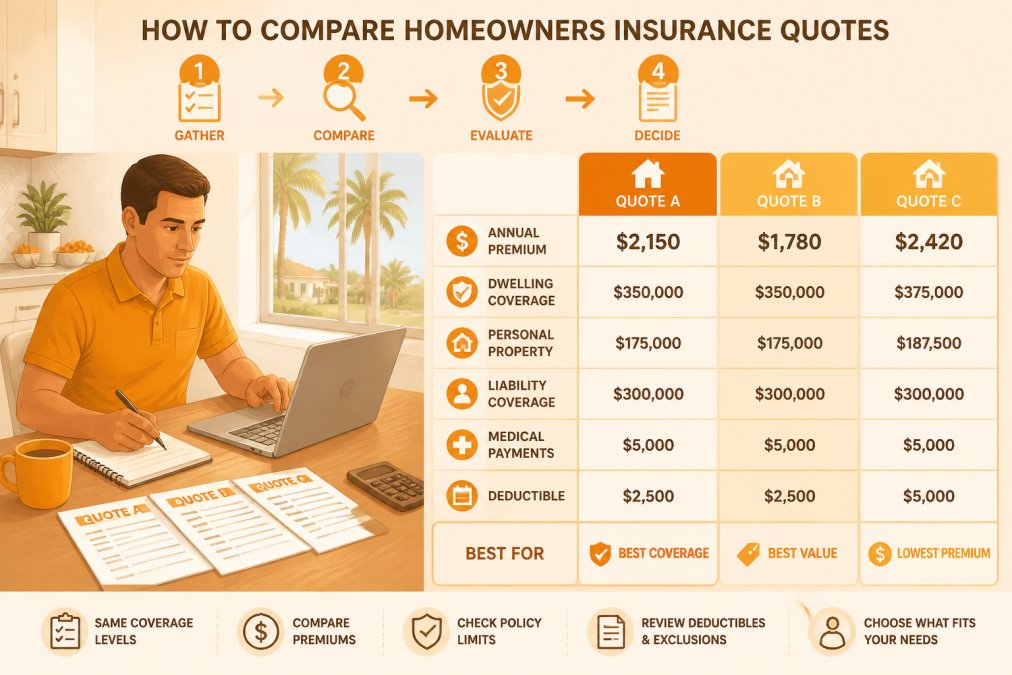
Here is the process we walk clients through:
- Pull your current declarations page. It lists your dwelling, personal property, and liability limits, plus both deductibles.
- Request identical quotes. Ask each carrier for the same dwelling coverage, deductible structure, and endorsements.
- Check the replacement cost estimate. Dwelling protection should reflect current rebuild costs, not your purchase price or mortgage balance.
- Verify the hurricane deductible. It is usually a percentage of dwelling coverage, so compare the actual dollar exposure.
- Confirm the carrier’s financial stability rating. An admitted carrier’s rating matters more than a low premium.
- Ask about mitigation credits. Wind mitigation features reduce your premium only if the carrier has documentation.
- Compare total annual premium, not monthly escrow. Escrow spreads the cost across twelve months and hides the real number.
A common mistake is comparing a quote with a 2% hurricane deductible against one with a $2,500 flat deductible. Those are not the same policy, and the premium difference reflects that.
Independent Insurance Agency Benefits for Florida Homeowners
The main independent insurance agency benefits come down to carrier access and advocacy. An independent agent represents multiple carriers rather than one, so a single application can be shopped across several admitted markets at once.
That matters in a market where carrier appetites change by construction type, roof age, and distance to the coast. A home one carrier declines may be perfectly acceptable to another.
Independent agents also handle the parts homeowners find hardest:
- Matching roof age and material to carriers that will actually write the risk
- Documenting wind mitigation features so credits are applied correctly
- Explaining coverage gaps before a claim, not after
- Serving as your point of contact when a claim is filed
There is a real difference between an independent agent and a captive agent who writes for one company. A captive agent can only offer that company’s products. An independent agent can move you when a carrier tightens underwriting or raises rates at renewal.
Ask any agent how many carriers they are appointed with and whether they can quote both admitted and surplus lines markets. If the answer is one carrier, you are talking to a captive agent.
Questions to Ask Your Insurance Agent Before You Switch
The right questions to ask your insurance agent before switching focus on coverage mechanics, not just price: what the policy excludes, how claims are handled, and what happens at renewal.
Bring this list to your next conversation:
- What is the dwelling replacement cost, and how was it calculated?
- Is the hurricane deductible a percentage or a flat amount?
- Does the policy cover water damage from a plumbing failure? What about gradual leaks?
- Is flood insurance separate, and do I need it?
- Are there coverage gaps between my old policy and this one?
- How are mitigation discounts documented and verified?
- Who do I call at 2 a.m. after a storm, and how fast will I reach a person?
- What triggers a non-renewal with this carrier?
That last question is the one most homeowners never ask. Underwriting guidelines change, and knowing a carrier’s tolerance for roof age or claim history tells you whether this is a long-term home or a one-year stopgap.
Coverage Types, Deductibles, and What Homeowners Insurance Covers
A standard homeowners policy covers four core areas: dwelling protection, personal property, liability coverage, and loss of use. Each has its own separate limit.
Dwelling protection pays to repair or rebuild the structure. Personal property covers belongings inside the home, usually at actual cash value unless you add replacement cost coverage. Liability coverage protects you if someone is injured on your property or you damage someone else’s. Loss of use pays for temporary housing if your home becomes uninhabitable.
Deductibles work differently than most homeowners expect. A policy typically has two: an all-other-perils deductible, often a flat amount, and a separate hurricane deductible, usually a percentage of dwelling coverage.
| Coverage Component | What It Pays For | What to Verify |
|---|---|---|
| Dwelling protection | Rebuilding the structure | Replacement cost vs. actual cash value |
| Personal property | Belongings inside the home | Sub-limits on jewelry, electronics |
| Liability coverage | Injuries, property damage to others | Limit amount, umbrella options |
| Loss of use | Temporary housing costs | Time limit and daily cap |
| Hurricane deductible | Named-storm damage | Percentage vs. flat dollar amount |
| Flood insurance | Rising water, storm surge | Separate policy, separate premium |
Flood damage is not covered under a standard homeowners policy (Buy a Flood Insurance Policy). It requires a separate flood insurance policy, and in a coastal state that gap is the one homeowners most often discover too late.
Two policies with the same premium can carry wildly different risk. Always compare the hurricane deductible as a dollar figure, not a percentage, before you decide.
How to Switch Home Insurance Providers Without a Coverage Gap
Most guides tell you to “shop around and switch.” Almost none walk you through the two steps that actually cause problems: getting your mortgage escrow account to follow the switch, and making sure your mitigation credits transfer with you.
Switching providers safely means binding the new policy before the old one ends. The sequence matters more than the timing.
Here is the order that prevents a lapse:
- Get the new policy quoted and bound with an effective date on or before your current policy’s expiration.
- Confirm the new policy is active and you have the declarations page in hand.
- Cancel the old policy in writing after the new one is confirmed, and request any unused premium refund.
- Update your mortgage escrow so your lender pays the correct carrier (see below).
- Re-verify your mitigation credits with the new carrier (see below).
- Store both declarations pages for at least one renewal cycle.
The most common mistake is canceling first and shopping second. That leaves you uninsured during the gap, and underwriters treat a lapse as a red flag on future applications.
Step 4 in detail: moving your escrow account
If your mortgage lender escrows insurance, the switch is not finished when the new policy binds. Your lender must be told in writing who the new carrier is and when coverage starts. Lenders track the mortgagee clause, the section naming them as an interested party, and pay the premium from escrow on a set schedule.
If the lender keeps paying the old carrier after you cancel, you can end up with a refund from the old policy and a missed payment on the new one. Worse, if the lender sees a lapse, it can force-place coverage, typically far more expensive than anything you would buy yourself, and it usually protects the lender’s interest, not your belongings.
A common pattern: send your lender the new declarations page and a short written notice the same week you bind, then confirm on your next escrow statement that the correct carrier is listed.
Step 5 in detail: re-verifying mitigation credits
Wind mitigation credits do not automatically follow you to a new carrier. Each carrier applies its own credits and wants its own documentation, usually a wind mitigation inspection report on the state’s standard form. Ask the new carrier exactly which features it credits and what proof it needs.
Typical credited features include a hip roof, a secondary water barrier, roof-to-wall attachments, and impact-rated openings. A home that earned a large credit with one carrier may earn a smaller one with another, so the quoted premium is final only once credits are verified.
Ask your new agent to confirm, in writing, which mitigation credits were applied and what documentation they used. That record protects you at renewal if the credits are ever questioned.
Frequently Asked Questions
What should I look for when choosing a homeowners insurance agency?
Start with licensing and financial stability ratings for the carriers the agency represents. Ask whether the agency is independent or captive, how many carriers it can quote, and whether it will verify wind mitigation or other discounts on your behalf. Confirm the agency will review coverage limits, deductibles, and flood insurance needs rather than just quoting the lowest annual premium. A good agency explains coverage gaps before you sign.
How do independent insurance agencies differ from captive agencies?
An independent insurance agency represents multiple insurance carriers and can compare quotes across them, while a captive agent works for one carrier only. Independent agencies can often find better pricing because they shop your risk profile across several admitted carriers and surplus lines markets. They also give you a single point of contact for policy renewals, claims questions, and coverage reviews across home, auto, and other policies.
Is it better to use an insurance broker or go direct to a carrier?
Going direct works if you already know exactly which carrier and coverage you want. A broker or independent agent helps when you want quote comparison across several carriers, need help understanding replacement cost versus actual cash value, or want someone to verify wind mitigation and other discounts. The broker’s role is to match your risk assessment to the right carrier, not to push one brand.
What factors influence homeowners insurance premiums in Florida?
Key factors include your home’s age, roof condition, construction type, and distance to the coast. Wind mitigation features like impact windows, roof straps, and secondary water barriers can lower premiums. Your claims history, deductible amount, and whether you bundle policies also affect rates. Recent legislative changes have shifted how carriers file rates, so reviewing your policy at each renewal is important.